ViniVault/Value
Use eBay prices when Discogs has nothing
Some records have no useful Discogs asking price. ViniVault can then look at recent sold vinyl listings on eBay for that album.
A fallback, not the first stop
Discogs is the first guide, using a middle asking price for a Very Good, Very Good Plus, or Near Mint copy. eBay is the fallback when that guide has nothing usable, matched by the artist and the album on vinyl.
Sold prices are still not a promise. A single odd auction can sit among recent sales. The figure is an average of those sales, used because there was no Discogs price worth keeping, not because it is a valuation.
You do not paste links or search eBay yourself for the total. If neither source has a price, the record stays out of the total and the count shows the gap. That is better than a made-up number.
A fallback, in this order
First the price you typed, if you typed one. Then Discogs. Then eBay. The order matters. A record with a typed price never needs the fallback, and a record with a proper Discogs guide does not get replaced by an auction.
You do not need an eBay account to catalogue the record. The lookup is part of the guide. It is not a listing, and it does not buy or sell anything.
How this works in ViniVault
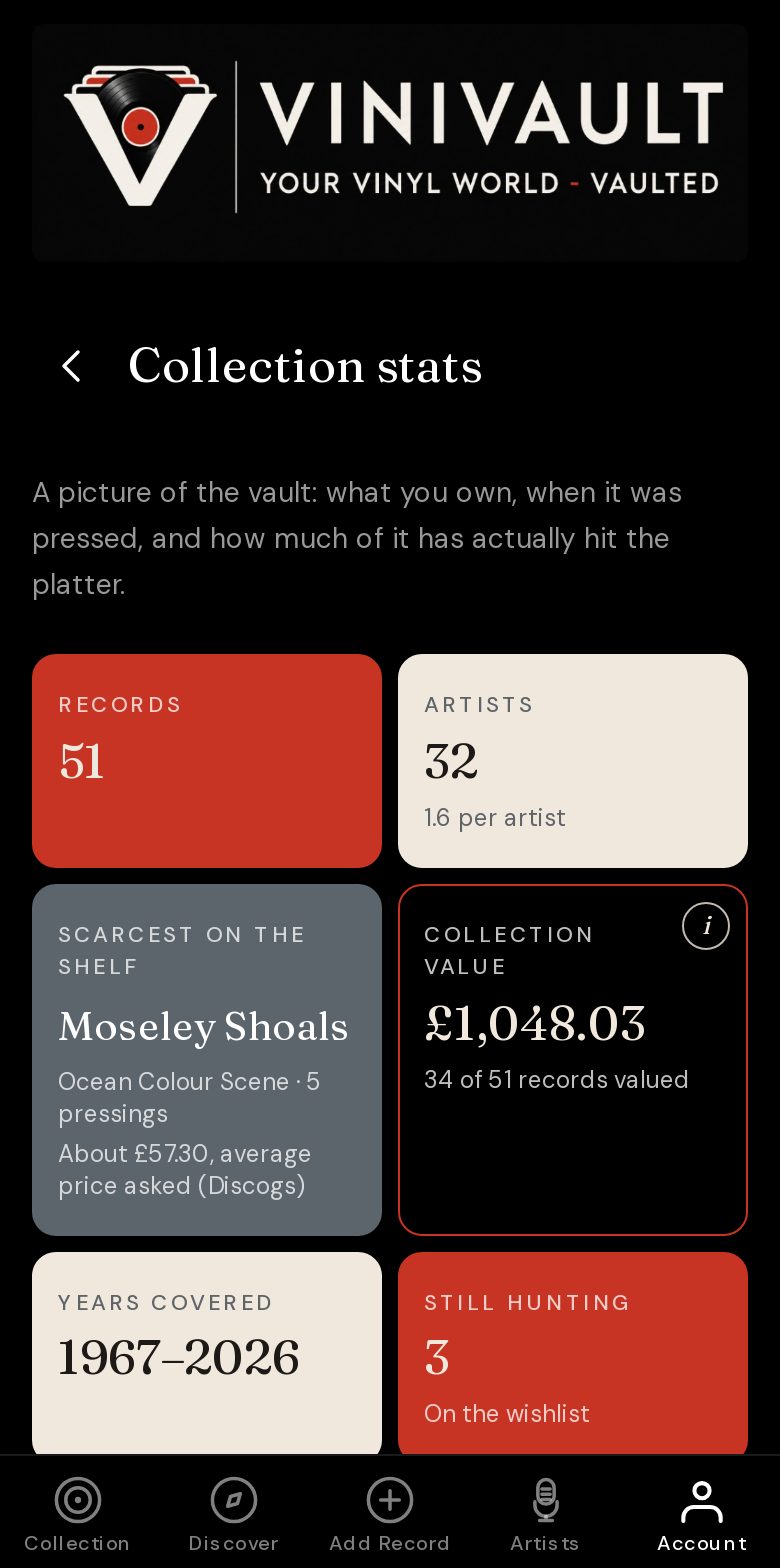
Collection value does this on its own when a Discogs price is missing. The record stays out of the total if neither source has a usable price. Type your own price any time you want to override that.
Penny listings are not treated as a real guide. A price that is only the cheapest ask, especially a token amount, is not stored as what the record is worth.
Questions
- Do I need an eBay account?
- No. You catalogue the record. The price lookup is part of the guide, and it does not list your copy for sale.
- Why not use eBay first?
- Discogs is the closer match to a pressing and a grade. eBay is there for albums Discogs cannot price, not as a replacement for a price you already have.